
"Starey Eyes" and Thyroid Lid Lowering Surgery - by Leading Oculoplastic Surgeon, Dr Sabrina Shah-Desai, in London

Thyroid Eye Disease (TED), otherwise known as Graves Orbitopathy, is the most common orbital disease in the UK - understand its causes and treatment options.

"Starey Eyes" and Thyroid Lid Lowering Surgery illustration

Accredited & recognised by

"Starey Eyes" and Thyroid Lid Lowering Surgery

At a Glance

Prevalence
1 in 20 people in the UK
Active Phase
6-18 Months
Monitoring
Every 4-6 Weeks
Treatment Options
Drops to Surgery
Why choose this treatment

Comprehensive Care for Thyroid Eye Disease

Comprehensive TED Care

From lubricant drops and steroids through to orbital decompression and lid-lowering surgery, care spans every stage of TED.

Staged Treatment Approach

Active, progressive disease is managed with steroids or radiotherapy, while restorative surgery is offered once the condition is stable.

Endocrinologist-Coordinated Care

Thyroid status is monitored alongside your endocrinologist to help you achieve and maintain euthyroid status.

Regular Monitoring

Thyroid status is reviewed every 4-6 weeks during the active phase to catch and manage changes early.

What is Thyroid Eye Disease?

Thyroid Eye Disease (TED) - otherwise known as Graves Orbitopathy (GO) - is the most common orbital disease in the UK, affecting 1 in 20 people. Thyroid Eye Disease is generally associated with thyroid immune disorders, such as Graves' Disease or Hashimoto's Thyroiditis, and affects more women than men - usually between their second and sixth decades.

Most patients with eye disease have a current or past history of abnormal systemic thyroid hormone levels, while some may go on to develop abnormal levels, and a small number of patients may be euthyroid. While 25 to 50% of patients with immune thyroid disease develop orbital involvement, commonly within 12-18 months of their hormonal disorder, 5 to 10% of these may develop more severe consequences - such as increased inflammation and congestion, impaired motility, or compressive optic neuropathy. Other contributing factors include smoking and a family history of thyroid disorders.

What causes Thyroid Eye Disease?

The cells of the thyroid gland (epithelial cells) are covered in surface receptors, which bind to the thyroid stimulating hormone (TSH, thyrotropin) - a hormone which is secreted by the pituitary gland to control the release of thyroid hormones. In both Graves' Disease and Hashimoto's Thyroiditis, thyrotropin-receptor antibodies (TSH-R Antibodies, TRAb) are also present, and these can bind to the receptors: initiating and perpetuating the disease.

These circulating antibodies are thought to be mediators in orbit disease, with their likely target being the orbital fibroblasts, which are found in the extra-ocular muscles and in the orbital fat. This is why orbital fibroblasts from patients with Thyroid Eye Disease have increased numbers of TSH receptors, which are thought to bind to circulating autoantibodies (TRAb): thereby stimulating fat cell formation and the deposition of hyaluronic acid within orbital muscle and fat - the histologic hallmark of Thyroid Eye Disease (see figure 1).
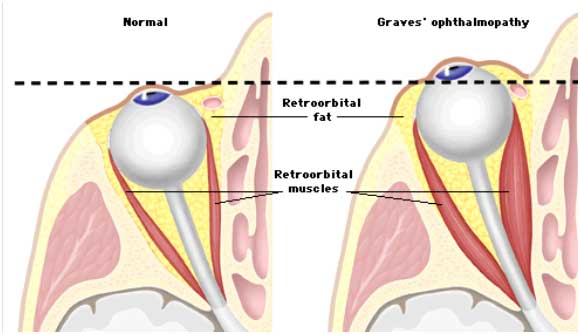
Enlargement of the fat and extra ocular muscles of the eye socket in Graves Orbitopathy

Fig 1: Enlargement of the fat & extra ocular muscles of the eye socket in GO

How do you treat Thyroid Eye Disease?

Thyroid Eye Disease symptoms are graded into activity (on a scale of 0 to 10, based on inflammatory signs) and severity (mild, moderate, severe and sight-threatening). While mild, non-inflammatory disease is generally treated with lubricant drops and oral selenium (200 mcg/day for 6 months), mild inflammatory disease may also require additional non-steroidal anti-inflammatory drugs (NSAIDS) or steroids. Double vision is managed with stick on Fresnel prisms, which can be placed on spectacle lenses to help realign the eyes. Immunosuppressive treatment with steroids, radiotherapy and surgery in the "active" phase is reserved for moderate and severe, sight-threatening eye disease with an increasing inflammatory index.

Pulsed Intravenous methylprednisolone has been found to be 85% effective, and oral prednisolone to be 60% effective in reducing inflammatory signs of Thyroid Eye Disease. Other immunosuppressive drugs like Azathioprine, Cyclosporine and Rituximab are also used in some cases. Urgent orbital decompression is a treatment option for sight-threatening dysthyroid optic neuropathy, whilst lid surgery is reserved for corneal exposure threatening the sight.

Radiotherapy has been found to be useful in active progressive disease, while rehabilitative or restorative surgery is offered once the disease is stable and quiescent in the post-inflammatory phase. This includes orbital decompression for bulging eyes, squint surgery to help correct double vision, lid-lowering surgery for staring eyes, and blepharoplasty surgery for eye bags. Rundle first described the activity pattern of the disease, and the plot of orbital disease severity against time has been called Rundle's curve (see figure 2).
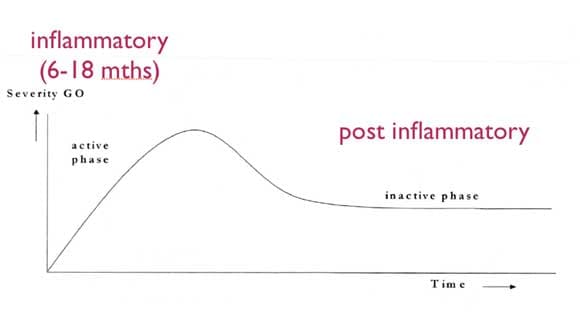
Rundle's curve showing thyroid eye disease severity over time

Fig 2: Rundle's Curve

Publications

Stability of eyelid height after graded anterior-approach lid lowering for dysthyroid upper lid retraction.

Thyroid orbitopathy possibly predisposes to late-onset of periocular lymphoma.
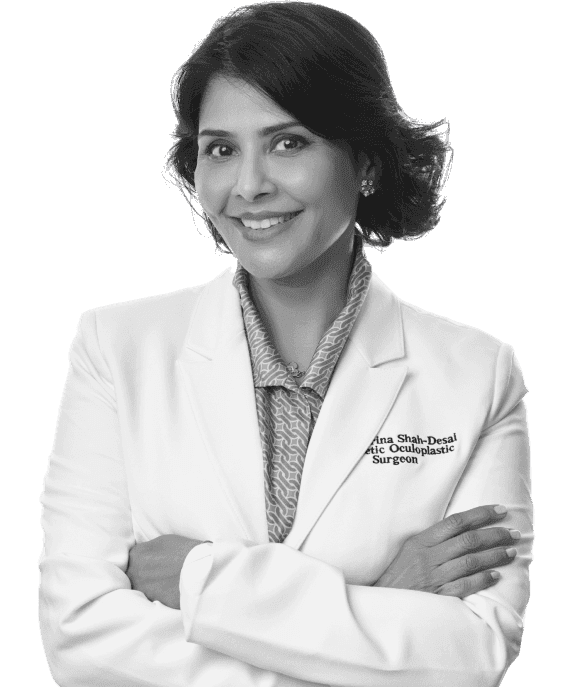
Dr Sabrina Shah-Desai

Meet the Expert: Dr Sabrina Shah-Desai

Dr Sabrina Shah-Desai is the founder and Medical Director of Perfect Eyes Clinic. With over two decades of surgical and non-surgical experience, she is considered one of the safest, most experienced oculoplastic surgeons in the UK.

Her extensive training, combined with her caring and empathetic nature, makes her a natural choice for patients seeking the very best care. Dr Sabrina appears consistently in Tatlermagazine as one of the UK's “Best Eye Surgeons” and “Top Doctors” since 2019.

Learn About Dr Sabrina
Royal College of Surgeons of England - register of Board-Certified Cosmetic SurgeonsBest Aesthetic Doctor - Safety in Beauty 2023Consultant Surgeon of the YearBest Surgical Result - Aesthetic Awards 2021Tatler Best Eye Surgeon 2019-2026
Patient Questions About "Starey Eyes" and Thyroid Lid Lowering Surgery

Frequently Asked Questions

The questions patients ask most often, answered by the clinic. If yours isn’t here, ask us directly - we would be delighted to help.

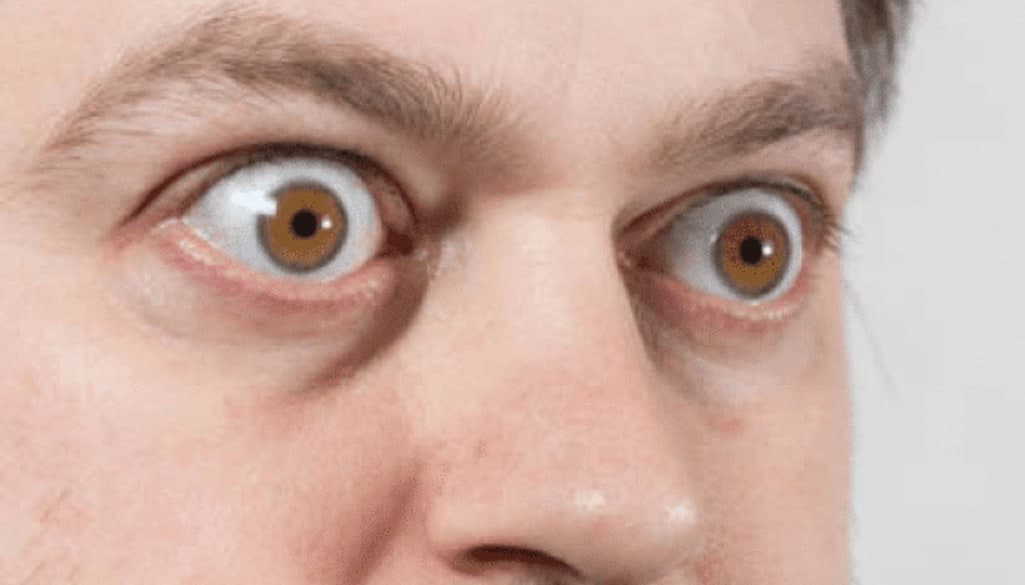
  • Thyroid Eye Disease is commonly indicated by sore, red and watery eyes with swollen eyelids; however, various symptoms are also frequently seen. 90% of Thyroid Eye Disease sufferers experience lid retraction (where the eyes appear to "stare"); 60% experience bulging eyes (known as Proptosis or Exophthalmos), and 40% suffer from double vision.

    Thyroid Eye Disease typically has an "active" (in other words, progressive) inflammatory phase, which can last between 6 to 18 months, followed by an "inactive" (stable) post-inflammatory phase. Rundle first described this pattern of the disease, and the plot of orbital disease severity against time has been called Rundle's curve.

    The steepness of the graph in the active phase reflects the speed of progression, with a steeper slope often leading to more serious side effects, which need to be actively managed. This is usually through the use of steroids, radiotherapy, or other immunosuppressive agents - in order to limit the destructive consequences of the active phase. Rarely the disease can reactivate: if it does, it is usually associated with a major life stress.
  • In the active stage, Dr Sabrina recommends making some positive lifestyle changes, in order to help you improve Thyroid Eye Disease. Adopting an anti-stress or mindfulness practice, such as yoga, Pilates, counselling, can help to improve your experience of Thyroid Eye Disease, while frequent monitoring of your thyroid status (every 4 to 6 weeks) is recommended.

    Smoking is known to adversely affect the course of Graves Orbitopathy (GO) and your response to treatment - therefore smokers are advised to quit (and if necessary, seek professional help to do so). Finally, you should aim to achieve and maintain euthyroid status - and this needs to be overseen by an endocrinologist, using medications or radioactive iodine or thyroidectomy. (Note: Radioactive iodine is contraindicated in young children, women, pregnancy & severe eye disease).

Call or email us today, we would be delighted to answer your questions.

Ask a Question or Book an Appointment
Patient stories

Rated five stars by patients across the globe

4.8out of 5 from 240+ Google reviews

Desi StevensRated 5 out of 5 on Google
Simply the best dermatologist for skin care and eye surgery. She is a safe and skilled doctor who is highly experienced and will meet your needs, her approach is a soft and natural aesthetic. She listens and communicates clearly, professionally and in a kind and personable manner. I have been looked after by Dr Sabrina for many years have always been extremely happy with her advice, procedures and results. Highly recommend, she is a talented Dr you can trust.
Kealey HesseyRated 5 out of 5 on Google
Dr Sabrina is the magic eye fairy. Only 10 days after my lower lid bleph and midface lift and nearly all bruising and swelling has gone. After a lot of research, I knew after my initial consultation with Dr Sabrina she was the one I trusted. Such a warm & kind woman. I am so pleased I put my Trust in Dr Shah. Immensely happy with the results and will be back to get my upper eyes done in the future. Thank you to the whole team.
Jo KirbyRated 5 out of 5 on Google
I had been recommended Dr Sabrina by a medical colleague & am extremely glad I made the journey from Southampton to the Perfect Eye Clinic in London to discuss blepharoplasty. The team were all so friendly & very professional and most importantly, Dr Sabrina informed me that I had a bilateral eye ptosis. This explained a number of issues I was experiencing. I will definitely be booking to have a correction of bilateral eye ptosis and upper blepharoplasty. Can't recommend enough.
Shirley FordRated 5 out of 5 on Google
I am so very happy with my experiences at Perfect Eyes. Dr Sabrina is an absolute Star. Extremely talented, very personable I just couldn't be happier with my results and her overall professionalism. But a big part of my review is how lovely the support staff are too. Namely Safiya and Lisa who greet you with such warmness and respect. I highly recommend this clinic as I have done so with many friends.
Radhika RajanRated 5 out of 5 on Google
Top notch surgeon. Dr.Sabrina Shah is the best. Very meticulous and focused. Very experienced and very skillful. Supported by a great team, Irvana at the office is efficient and directs empathy as well towards nervous patients like myself . All in all a great experience.
Tina StonelyRated 5 out of 5 on Google
Dr Sabrina is so so kind and thorough in really assessing and understanding my needs and explaining in detail what works and the pros on cons of each treatment. I trust her implicitly and know she is the best physician in the UK and trainer to physicians for all aesthetic treatments. I cannot recommend her enough. You will not be disappointed choosing Sabrina.
Tanya Del FedericoRated 5 out of 5 on Google
Perfect Eyes provides an exceptional experience from start to finish. The team is warm, professional and highly knowledgeable, and every aspect of the consultation feels thorough and personalised. Sabrina combines outstanding surgical expertise with a genuine commitment to achieving natural, elegant results, taking the time to explain every option and ensure patients feel completely at ease. The care, attention to detail and standard of service are second to none. I would highly recommend Perfect Eyes to anyone looking for expert oculoplastic and aesthetic care.
Minda WangRated 5 out of 5 on Google
I am so happy with my experience. The results look natural, and I feel like a fresher version of myself since having my Biostimulation treatment with Doctor Sabrina. The whole experience was comfortable and professional, and I felt supported and well cared for throughout. I would definitely recommend this treatment to anyone looking for a natural-looking boost.
Samantha AndrewsRated 5 out of 5 on Google
Amazing. I’m so happy with the results. Sabrina is a master. She also has a wonderful bedside manner. I can’t recommend Sabrina and her team enough. Worth double the money. 👏🏻
Hayley PearsonRated 5 out of 5 on Google
I was lucky enough to first meet Sabrina 9 years ago & have never used anyone else since. She has helped transform my appearance; with natural looking aesthetics. I currently live abroad, however remain dedicated to stay a patient of Sabrina. What’s 3,500 miles when you have found the best in the business!

Book Your Consultation Today

Get personalised advice and expert care from our top medical professionals at 121 Harley Street, London.

Visit us
121 Harley Street, London
Mon to Fri9:30am to 6:00pm
Sat & SunClosed
Contact us

Contact our clinic

Speak to our team about which treatment suits you, or arrange a private consultation at 121 Harley Street.

Call or message020 7183 5121
Opening hoursMon to Fri9:30am to 6:00pmSat & SunClosed
Our locationPerfect Eyes Clinic, 121 Harley Street, London, W1G 6AXGet directions

Request a call back